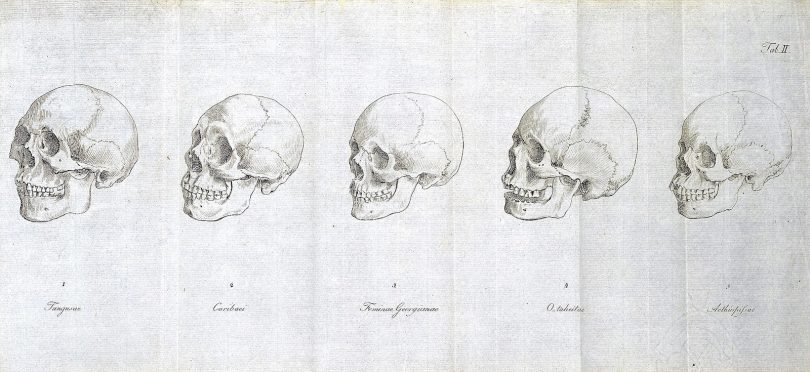
Vocabulary TransmedicalismThe belief that you need to have gender dysphoria and seek medical transition to “cure” it in order to be transAnthropologyThe study of peopleCraniologyThe study of skulls (of different human races)ZoologyThe study of animalsRace SciencePseudo-science that is used to justify racismBio-essentialismBelief that certain individual qualities are innate in humans Gender EssentialismBelief that gender is fixed in human nature (specifically the European binary “man” and “woman”)EugenicsBelief in getting rid of socially undesirable traits among populations of peopleVaginoplastySurgery that involves constructing or reconstructing the vagina Medical transition for people now known as transgender is a little more than one hundred years old. Hormone replacement therapy and gender-affirming surgeries can save lives– a fact supported by nearly every major medical organization. Despite overwhelming evidence of its positive impact, though, gender-affirming care is being banned and criminalized across the country. Meanwhile, other legislative and policy measures continue to endanger trans people in public. This is an egregious attack on our autonomy, but unfortunately some have adopted a reactionary response: transmedicalism. Transmedicalism is the belief that you must have gender dysphoria in order to be trans, and that you must receive or at least want medical treatment. Some believe trans people who medically transition and “pass” as cisgender should be centered in “the” trans experience, but where does this idea come from? Its history can be traced to the construction of sexual difference and its ties to white Eurowestern supremacy. Colonialism, Slavery, and German Brain Power When people think of colonialism and slavery, they rarely think of Germany. Colonialism is much more often associated with the English, the Spanish, the French, the Dutch, and the Portuguese. They had colonies all over the world and were the main benefactors of the colonization of the Americas and the Atlantic Slave Trade. While the Slave Trade ended in 1836, colonization of the Americas is still an ongoing project. Though the countries mentioned above were the most active, other countries like Germany participated in constructing Western dominance over the world. In fact, Germany provided the intellectual foundation for European colonialism at least up until the early 1900s. Colonial violence gave Europeans access to the bodies of racial Others to use for scientific study. German physician Johann Friedrich Blumenbach had a collection of skulls, and was the “scientist” who helped divide humans into five different races in the 1700s. His contemporary, Friedrich Tiedemann, believed that Black people had smaller brains than white people and were intellectually inferior. These scientists helped found the fields of anthropology, craniology, and zoology. They laid the foundation on which further division is constructed to this day. These scientists, who were tied up in race science, helped essentialize the sexual differences that led to today’s views of gender. The Construction of Sexual Difference and The Feminine Type Contemporary understandings of sexual difference emerged from the work of race science. Before and during the Renaissance era, European thinkers believed that women were just inverted men. This was called the One-Sex Theory, wherein the division between “man” and “woman” was far less rigid. This changed in the 17th and 18th centuries when contemporary gender roles became codified under the guise of science. In European thought, difference helps construct hierarchy. Something cannot just be different; it is different and substandard. Any deviation from white cisgender masculinity was considered inferior. That inferiority then justified oppression and the violences that white men perpetrated overseas and throughout Europe. For the 18th-century race scientists, observation and sight were central to their research method, establishing a dependency on visual “evidence” that persists in medicine today. German researchers such as Christoph Meiners, GWF Hegel, and Johann Alexander Ecker helped establish visual standards for femininity. Their belief that one’s gender is visibly and immediately recognizable underlies today’s assumptions that gender is an outward manifestation that others can diagnose upon first glance. The presumed visual cues that scientists attached to gender stereotypes then also informed racial hierarchies. According to Johann Alexander Ecker, the “feminine type” was defined by having no brow ridge and smaller features. In his view, women were intermediaries between children and men both in biology and social standing. Importantly, this “type” did not just include women but also East Asians. Women who were not white were left out of the feminine type and just took on the racial type of their “men.” In these racialized gender binaries, Black women are regarded as hypermasculine and aggressive and Asian women as hyper-feminine and submissive. The feminine type is defined by what white men see as desirable in white women– a standard that will always render women of other races as lacking. Once the feminine type became a presumed biological “fact,” sexual difference became not only universally gendered but racialized based on this type. Sexual Anthropology and the Origins of Trans Medicine In the mid-19th century, with the division of gender in European societies determined by “biological fact,” the field of anthropology turned its gaze to human sexuality. Karl Maria Kartbeny coined the terms homosexual and heterosexual in a letter to Karl Heinrich Ulrichs in 1868. Ulrichs is considered the pioneer of sexual anthropology or sexology and gay rights, and Kartbeny proposed these terms as alternatives to Sodomite. Before science and biology were used to oppress sexual deviance, it was Abrahamic religion. Kartbeny was one of the first advocates for what we now call LGBT rights. He wrote pamphlets arguing that same-sex relationships were not a morally sinful choice and that sexuality was innate or biological (the foundations of the “born this way” argument). Kartbeny’s approach set the scene for the way we talk about sexual minorities today. The term “bio-essentialism” names this belief that certain qualities are fixed by human nature rather than a matter of choice. This belief endures, which makes sense given how Western discourse has shaped our views of difference and hierarchy. Arguing that homosexuality is innate affirms the idea that being male and female are essentially different and biologically-determined. This concept is called gender essentialism. Bio-essentialism and gender essentialism formed the basis of campaigns for sexuality rights in the West– and the now-worldwide LGBT liberation movement. Among the widespread work influenced by Karl Heinrich Ulrich was that of Magnus Hirschfield. A German physician and scientist, Hirshfeld believed in an innate sexuality and helped establish contemporary Western approaches to gender and sexual identities. He coined transvestite in 1910. Though now outdated, transvestite originally referred to people who dressed as the “opposite sex.” Of course, this too is a cultural construct. Clothes do not have innate gender– and many cultures do not have such strict binaries when it comes to clothing. At the time, however, this belief was a convenient way to stigmatize those who did not conform to European sartorial standards. While Hirschfeld might seem like a progressive force in European thought, his beliefs also stemmed from eugenics, and he was predictably anti-Black. Even though he claimed not to believe in a racial hierarchy, he believed Black people had stunted brains– another form of weaponized biological essentialism. Hirschfeld went on to open the Institute for Sexual Science and provide medical care and counseling for gender-nonconforming people. This institute was the first of its kind in the West, and Hirschfeld helped develop the gender-affirming care practices we know now. Conclusion This is the beginning of trans medical care as we know it. From gender essentialist construction to the first gender-affirming care clinic, you cannot separate advancements in trans medicine from colonialism and race science. An inherently white supremacist and cisnormative standard, it cannot be the standard by which we measure trans identity. In the next installment, I’ll explore in greater depth the origin of transmedicalism.