
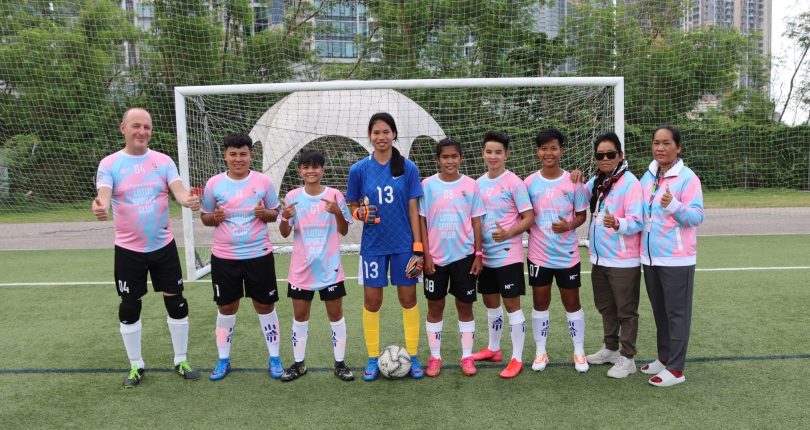
(cover photo by Gay Games Hong Kong) On December 8, British lawmakers signed a letter urging the Football Association (FA) to revise its policy banning athletes assigned-male-at-birth from women’s teams. This followed incidents in November when four women’s league teams withdrew from matches against Rossington Main Ladies, whose roster included trans woman footballer Francesca Needham. Currently, the FA allows adult trans players to play in a league based on their “affirmed gender.” Each application requires athletes to meet specific testosterone levels, and decisions are made on a case-by-case basis. Despite Needham meeting every requirement set out by the FA, she was eventually “forced to quit playing due to perceived discrimination against her.” In a contrasting move on the opposite side of the world, Gay Games Hong Kong (GGHK) has taken a groundbreaking step by introducing an “All-Gender” category in soccer, which allows athletes to compete together regardless of gender identity. Gay Games Hong Kong was held on November 3-11 amidst political and COVID challenges. A few sports, including soccer, mahjong, and dragon boating, are among the 18 official sports to have implemented an All-Gender category. Soccer took center stage at GGHK, especially with the involvement of Lotus Sports Club. This national champion team consists of trans and queer Cambodian players, who were featured in the award-winning documentary Lotus Sports Club (2022). I interviewed Emery Fung, the soccer lead and Director of Diversity, Equity, and Inclusion of GGHK, to discuss how the organizers have experimented with the All-Gender category, setting examples for alternative sporting categories regardless of sexuality and gender. According to GGHK’s Gender Inclusion Policy, the community sports event is committed to creating “alternative formats” of competition categories such as “mixed gender competitions, specific non-binary competitions, or open competitions with no gender categories at all.” Emery highlighted that GGHK fosters an “inclusion-first” space, encouraging “experiments” and embracing “trials and errors” in categorizing athletes. Explaining the All-Gender category, Emery clarified that it is designed to be inclusive for athletes of all sexual and gender identities. To respect participants’ privacy and avoid disclosure of their sex/gender, GGHK recommends that teams playing in this category include players from at least two genders without strict enforcement. Emery distinguished the All-Gender category from a Mixed category, highlighting that the latter still relies on a binary notion of gender. In a mixed-gender soccer match, there is often a specified quota for female athletes, reinforcing presumed binary differences between male and female. The All-Gender category aims to challenge this binary gender and quota system in sports, creating an inclusive space for nonbinary and intersex athletes who may not identify within the traditional gender framework. It also provides a safe space for trans athletes at various stages of transition, preventing them from being labeled based on their sex assigned at birth. The category also departs from an Open category, which often segregates trans women, nonbinary, intersex, and sometimes trans men athletes into a separate, “inclusive” category, away from the women’s category. As the first visible trans man soccer player in Hong Kong, Emery shed light on the challenges faced by many soccer players in the city who may identify as trans but opt not to undergo the laborious process of changing their gender markers to play on the men’s teams. Despite undergoing medical transition through testosterone use, Emery remains on the women’s team, as his identity document still lists him as female, even though recent changes in the city’s requirements no longer mandate sterilization for trans men to change their legal gender. Unlike the withdrawal of women’s teams in protest of Needham’s participation, Emery’s choice to play for the women’s team faced minimal opposition from other women players. However, uproar around supposedly (trans)masculine athletes playing for women’s teams persists in Asia, driven by a gender essentialism similar to arguments targeting trans women. Many claims presume unfair advantages for trans men, irrespective of their medical transitions. For instance, Cambodia’s Lotus Sports Club, a women’s soccer team “dedicated to girls of all sexual orientations,” is consistently criticized for having “boys” playing in the women’s team. Salun, a genderfluid Ph.D. candidate at the University of Hong Kong who works closely with Lotus Sports Club, clarified that the queer Cambodian members of the team don’t neatly fit Western notions of lesbian and transgender. Some players, identifying as “lesbian short hair,” present themselves in opposition to Cambodian societal norms of femininity. Expressing a desire for more masculine appearances, these players cut their hair short and occasionally bind their chests. While socially identifying as men, many do not wish– or have no access– to undergo hormone replacement therapy. In other words, they have not undergone any medical treatments that would alter their hormonal or physiological compositions from their sex assigned at birth. However, the Cambodian sports community often perceives them as embodying more strength and power than cisgender women. For Lotus Sports Club players, competing in an All-Gender category was an entirely new and unexpected experience. At the Gay Games Soccer 7s, 14 out of 16 teams had at least 2 different genders on the field. Emery praised the soccer tournament as a success in crafting spaces that experiment with alternative sporting categories and challenge today’s stigma against gender-expansive players. He expressed the importance of creating an environment where people of diverse identities can play together without fear of exclusion or anxiety about disclosing their gender. Although an All-Gender category ideally creates an inclusive space, its implementation comes with challenges. While members of Lotus Sports Club cherished the opportunity to compete overseas with players of different nationalities, abilities, and genders, Salun expressed a common concern about All-Gender categories in sports. They noted that assigned-male-at birth teams often won matches because they were “taller, stronger, and faster” than teams with a majority of assigned-female-at-birth players. (See our prior article on social and cultural factors that grant cisgender boys far more opportunities and resources for developing athleticism than other folks). Emery acknowledged dissatisfaction among some players due to competitive teams skewing their rosters to maximize their chances of winning. Lotus Sports Club members, according to Salun, had to adjust strategies when playing against teams of cisgender men, attempting to use their smaller size to their advantage but often falling short. We need thoughtful, nuanced, and inclusive considerations of the role of gender/sex physiology in team sports. While one cannot entirely discount the physiological and social advantages that cisgender men benefit from in many events, team sports require a diverse combination of skills. Emery explained that mainstream soccer training is highly segregated by gender, emphasizing strength and speed for men and strategy for women. An All-Gender category in soccer could potentially bring creative combinations of players from different training backgrounds, enhancing overall athletic performances. Normalizing All-Gender categories could also shift the inequitable cultures through which children and adolescents are introduced to athletics. Community sports events like GGHK offer opportunities for organizers to experiment and learn about the possibilities and drawbacks of All-Gender categories in sports. Emery and Salun both acknowledged that while the All-Gender category is far from perfect, “we have to start from somewhere.” Siufung Law (they/them) comes from Hong Kong, is a TEDx speaker, a nonbinary professional bodybuilder, and Ph.D. student at Emory University. They are a trans activist actively promoting the transgender-only bodybuilding competition in Atlanta, GA, organized by the International Association of Trans Bodybuilders and Powerlifters (IATBP).
Layout G (list + load more)
2023 in Review: The Top 5 Shut Up Fool Awardees of the year
As we approach the end of 2023, it is time to reflect on some of the most memorable and fool-tastic behaviors of the year. Without further delay, the top five recipients of the Shut Up Fool Awards in 2023. In fifth place is a well-known TV star who’s made a career of false promises– on and off his shows. The former president made many public appearances this year, while on trial and never at a debate. We finally heard him say he lost his race for re-election, but he remains in good standing with many– because, well, fans. India Arie takes fourth place on our list for making anti-black comments about fellow artists at Essence Fest. Her remarks were widely criticized by fans and other artists, but she only dug in further, promising to bring the same critical energy until we change. Third place goes to high-profile entertainment crasher Lauren Boebert, who had to be escorted out of Beetlejuice for “inappropriate behavior” with her date. The two were caught on video vaping, making too much noise, and– as the Guardian put it– “eagerly groping” each other in the theater. The consequences for her behavior should be a reminder that people of influence are not above the law and public decency. This incident, however, did not result in significant damage to her career or reputation; Lauren already did that on her own. JKKK Rowling is the second-place recipient for making a series of anti-trans remarks while supporting Elon “Cis’Slur” Musk’s statement that cisgender would be considered a slur according to X’s terms of use. Rowling provides a reminder that our words and actions have an impact– especially those of us with powerful platforms. That lesson, ironically, is part of her “best-selling” formula, and the principle on which she has built her abundant privilege. Finally, the most-deserving recipient of the Shut Up Fool Award in 2023, George Santos, who has been charged with conspiracy, wire fraud, false statements, falsification of records, aggravated identity theft, and credit card fraud. Next stop on his political career: Orange is the new Black. Such a stunt queen. What do you think about this lineup? Do you see someone missing? Maybe a remix of this top five? The year is not over, and there’s plenty of time for a fool to fool. Please let us know who would be in your top five, or tell us about that one thing that one fool did that had you like YOOO. Next week, we will award a fool of the year. The past few months gave us quite a bit of entertainment. I cannot believe we will be so much closer to 2024, preparing for a new year of new– or maybe familiar– awardees.
Inclusion at the Grassroots Level: How IATBP’s Sporting Categories Transform Powerlifting
(cover photo by Ames Beckerman) In the early morning of November 18, I joined the organizers of the International Association of Trans Bodybuilders and Powerlifters (IATBP) as we headed to the home of the executive director, Bucky Motter. We gathered at Bucky’s place for the final preparation of the organization’s most important event of the year: a powerlifting meet and a bodybuilding contest that “represents the future of transgender bodybuilding and powerlifting.” Having recently become a board member and ambassador in 2023, I was excited to witness firsthand how IATBP has transformed the bodybuilding and powerlifting communities. Their commitment to inclusivity is evident through the creation of sporting categories that reject classifying athletes based on biological sex. What sets IATBP apart is not merely its organization of the first bodybuilding and powerlifting competitions for trans people by trans people, but it creates new competition and meet divisions for transgender, nonbinary, and gender nonconforming athletes based on gender identity and gender expression. In both sports, IATBP categorizes athletes into four divisions: Masc, Femme, Gender Nonconforming, and Open. These first three divisions are further subdivided into weight classes and/or duration of Hormonal Replacement Therapy. Amidst the anti-trans athlete ban enforced by elite sports federations, these grassroots-level sporting categories become particularly significant for trans and nonbinary powerlifters, providing a countermeasure against the backdrop of transphobic violence within sports institutions. Before international sports governing bodies implemented bans on trans women athletes, USA Powerlifting had already imposed one of the strictest transgender policies in 2019. Following trans woman powerlifter Jaycee Cooper’s victory in a local powerlifting championship in the women’s category in early 2019, the USA Powerlifting governing board voted to prohibit all trans women from competing in the female category. That same ruling also prohibited all trans men who had undergone hormonal transition from competing at all. Despite Cooper winning the discrimination lawsuit against USA Powerlifting in March 2023, the exclusionary transgender policy has not been retracted to include trans athletes. Instead, trans and nonbinary powerlifters are forced into a MX division, created shortly after the ban. This third category was supposed to be an inclusive gesture to embrace athletes of “all gender identities,” such as transgender women, pre-transition transgender men, intersex, gender nonconforming, and nonbinary athletes. However, the MX category is largely criticized by trans sports activists and groups as a “harmful othering” that only “furthers the isolation and discrimination trans athletes face.” Angel Joy Flores, a trans woman powerlifter, shared her unpleasant experience with USA Powerlifting after participating twice in the MX division. Initially, she intended to use her lifting records to show that trans women are just like any other women. However, Angel was disheartened by the treatment she received from the federation, describing it as “not one of the best experiences she has ever had, to put it nicely.” Consequently, she decided that she would never compete again in the MX category, despite her competitive nature and desire for a space to compete. Angel emphasized the importance of grassroots powerlifting meets like IATBP, highlighting their role in creating inclusive and fair environments for trans and nonbinary athletes to compete without the fear of compromising their gender identity. Under the guidance of Janae Marie Kroc, the renowned bodybuilder and powerlifter whose life was documented in the award-winning film Transformer, IATBP has created one of the most transformative powerlifting meets I have ever witnessed. Every lifter I spoke to during the event expressed their gratitude and joy at competing at IATBP. Not only are competitors free to participate in any and multiple divisions of their choice, but they are also judged fairly using a modified Wilks coefficient to measure their strengths. Squee, who won second place in the nonbinary division in 2021, greeted me with a cheerful smile upon my arrival at the competition venue. They invited me to join their Signal group, an online community formed by former IATBP competitors dedicated to sharing powerlifting knowledge. The group serves as a platform for discussion on topics such as competitions welcoming trans participants, training programs, lifting equipment, and gym recommendations. The Signal group functions as an inclusive and safe online space, offering trans and nonbinary lifters a refuge from the transphobia often encountered in mainstream sports environments. Apart from this spontaneous, bottom-up community building initiated by the athletes, trans and nonbinary lifters touched me with their uplifting energy and generous attitudes. Unlike mainstream sports competitions where athletes compete against each other, IATBP lifters compete for each other. Their support extended beyond familiar faces, as they cheered for other trans and nonbinary athletes they did not know, and coaches readily assisted lifters in need of a spotter. What struck me most was the nurturing environment created by trans and nonbinary lifters, where they could be judged based on their abilities rather than their gender identities. The fair and caring atmosphere IATBP offered inspired Rufio and Scott — two trans coaches who had competed at a previous IATBP — to bring their athletes to the meet, ensuring they could have a positive first-time competition experience. After the official meet, the sense of camaraderie persisted as athletes and coaches stayed at the venue, demonstrating lifts and exchanging lifting techniques. This collective commitment to mutual support and shared growth showcased the unique and empowering nature of the IATBP community. Lifters shared with me how IATBP’s inclusive environment made them feel seen and transformed their lifting experiences. Trans and nonbinary athletes perform better when they do not need to worry about a transphobic world and can focus on their passion for lifting and mutual support. What these lifters and IATBP organizers have taught me is that inclusivity can be achieved at the grassroots level; it begins with letting trans and nonbinary athletes exist and succeed.